It’s in the books stupid!

untitled

All this life ‘beyond levels’ stuff is very interesting. (I say that as someone who counts the number of sleeps before the RaiseOnline release date so you’ve been warned.) But I mean isn’t it though? Having to completely revolutionise the way you assess pupils whilst simultaneously getting to grips with a new national curriculum? If not interesting, it is, at the very least, a new challenge in education.

It is not just the practicalities that are interesting (watching each teacher’s brain melt inside their skull as they try not to peek at their APP statements whilst assessing a piece of writing); the discussions it has brought about are equally riveting.

There are the online conversations: fierce battles between those that loved levels, those that hated levels, those that have dreamt for the day when a 2B became as meaningless as it was interpretable, those that vowed to leave education if levels became defunct (as if it was in some way similar to a 95 pence supertax law), those that cynically denounced any other assessment system as ‘well it’s just levels in sheep’s clothing isn’t it’, and those that relished the thought of a convolutedly simplistic system that would come to define their appraisal prospects.

Then there are the fake real-life conversations – mainly conducted by sales reps offering a simple ‘Like levels but definitely not levels’ sales pitch, promising that all these systems will guarantee smoother progress trajectory patterns in each and every year group and, as long as you book out all five of your insets for their training, won’t cause your teachers any grief at all.

There are then the ‘real’ real-life conversations between schools:

Outstanding school not due to be inspected for another ten years: So what are you doing?

RI school about to be inspected: Well, we’ve had to get the ball rolling in case the big O rock up and want to talk life beyond levels, so we’ve launched a new system starting in every year group based on awarding pupils points according to a set of predetermined threshold criteria in every subject. Eight times a year these points are collected, averaged out and spread over an evaluation matrix that shows you exactly where the child was three months ago. However, we are still using levels as a back-up in Years 2 and 6 (obviously) but also in Year 1, 3 and 5. What are you doing?

Outstanding school not due to be inspected for another ten years: Oh we’re just sticking with levels. But do let me know how that system works out won’t you.

And don’t get me started about the conversations between staff members. Young teachers who only know levels and haven’t got the experience or confidence to look at a piece of work and go ‘Yeah, that looks about right for a seven year old’. Old teachers who have only ever used levels and can be seen wandering the school corridors clutching a crumpled and faded A3 APP spreadsheet like a security blanket. Ancient teachers who have only just got used to using levels since the days of educational freedom (which also happened to be the days of low standards, no planning, caning, and the occasional employment of non CRB’d paedophiles). Get a load of those teachers talking and the panic sets in faster than the reversal of achievement after the summer holidays.

As far as I can see the panic is caused for mainly two reasons:

  1. How will we know any new system works?
  2. What if I’m the only one it doesn’t work for?

To answer these questions we have to seriously ask ourselves what exactly are we looking for? Now, before you accuse me of coming over all Zen, let me explain. A large part of the conversations I have had with lots of people about life beyond levels is about children making progress. ‘I mean’, I hear the odd teacher cry, ‘If I don’t understand this crazy new system or use the system correctly, my children won’t make progress.’ WRONG. If you use the system incorrectly it will appear on paper that they have not made progress. In reality, they will have made exactly how much or how little progress your teaching has allowed. Progress is not determined by data – data does not even reflect actual progress. All data does is present a pattern of apparent progress, based on one individual’s interpretation of the progress measures being applied.

That is what is so gloriously silly about life beyond levels. It’s a sham. It’s not even the emperor’s new clothes. In the tale of ‘life beyond levels’ the emperor was butt naked from day one. Nobody really knew what a 2B was in writing – not to the extent that their judgement would chime exactly with every other practising teacher in the land. Nobody agreed with every single level judgement that came back from the SATS marker. No child ever graduated from one level to the next because of the inclusion of a single level descriptor. It’s all a nonsense.

Children make confusing, conflicting, incremental steps of progress all the time because, well, because they’re children: complicated little sods whose gradual rates of achievement occur like stages of evolution. You often can’t pin down exactly when it happens but, over time, it just does…providing?

That’s just it isn’t it? Progress happens providing the teaching is good and I don’t gauge that from data. I get it from monitoring the work of teachers: the planning, the teaching, the marking, the next steps. In short: It’s in the books stupid. Don’t worry about the system – that will sort itself out and settle itself down and be as accurate and frustrating as all ‘one size fits all’ systems have ever been. Yes, I’ll always check to see if the data patterns match up with what I see in the books and, when they don’t, I will investigate and support. The data may trigger an increased interest in your practice, but it won’t be the damning evidence that turns me into judge, jury and executioner. So, don’t panic, keep meeting the needs of your pupils, and the representation of your hard work through the ones and zeros of your data will look after itself.

Now get to bed – only 325 sleeps until the last ever RaiseOnline.
Oh what a lovely war

I read an article the other day about the final Hobbit film that is due to open this Christmas: ‘The Hobbit: The battle of the five armies film to end in 45 minute battle scene‘ screamed the headline. Can you imagine that? A great war between aloof elves, socially repressed ogres, single-minded orcs, sniping goblins and smug wizards. I imagine, sat in the cinema, it will be a never-ending stream of trolling. Now, I hate to be the one to break it to Mr Jackson, but 45 minutes of watching the same boring fight over and over again is nothing compared to what Twitter’s education community is capable of. We of course only have two armies: Progressives and Traditionalists. But, even so, that doesn’t stop them from battling continuously over hallowed yet uncommon ground. Aside from being hell-bent on knocking seven shades of pedagogy out of one another, each side is resolutely unforgiving of their opponent’s fighting methods.

I will now, dear reader, summarise the main differences between the progressive and traditionalist approaches to teaching. Actually, no I won’t, it’s far too boring. Look, just close your eyes and give your Twitter timeline a big old swipe…I guarantee you’ll land on a link to some blog that will explain it all. As the saying goes:

‘In the land of Twitter education, you’re ne’er more than 2 tweets away

From a progressive or traditional teacher, desperately having their say.’

I have often said that I don’t know what being a ‘progressive’ or a ‘traditional’ teacher actually means, and I’ll admit now that this is only half true. I do know the broad differences in ideology. Traditionalists are Victorian time travellers who know everything and believe that children should just shut-up, listen and graft silently until they bore a hole into their little wax slates. Progressives, meanwhile, mainly teach through the medium of dance, believe that there is no such thing as a single answer and that children can only work if playing in groups. The only characteristic these two types share is a fundamental belief that their opponents are singlehandedly ruining the education of this country.

In terms of who is winning the battle, it’s possible that the traditionalists are at the moment. We seem to be entering an age of educational austerity. I guess that comes from a few years of a Conservative government, one secretary of state’s worryingly self-absorbed obsession with reshaping the educational landscape to suit his own ego, performance related pay and Ofsted’s demand that progress is made within twenty minutes by every child. All of this encourages weak leaders to put pressure on teachers to produce ‘results’. In this climate, rote learning, sharp discipline methods and the testing of facts in order to prove capability kind of supports a traditionalist’s approach. And with the recent Sutton Trust research project that suggests even giving praise is a waste of bloody time, you could be forgiven for being a rather smug traditionalist at the moment. The mere thought that we could make a difference by allowing children to work together, by encouraging role-play beyond a drama lesson, by bringing empathy into learning, by making lessons ‘fun’ is sheer madness isn’t it, you risk averse robotic kill-joy?

But hey, that all sounds like I’m anti-traditionalist, and that is not the case. I have, for some time, been concerned that the public demand on schools has become too wide ranging. We are teachers. We teach children stuff and that’s where it should end. Society expecting us to do everything in terms of a child’s development is just not on. Parents expecting a teacher to design a personalised curriculum on the basis of their child’s interests-without a care for the other thirty children in the class or the national curriculum-is also just not on. It’s selfish and smacks of a middle-class sense of entitlement run amok. If children are unsure of school rules or how to be polite, it is the school’s job to give them higher expectations and sanction them when they fall below them – and if parents can’t understand that the school’s behaviour policy is in place for their child too, then schools should have the power to give the parents a detention as well as the kids! (See, not so progressive now am I?)

However, what always strikes me as odd and depressing, as I get engulfed by the hot air caused by a Twitter-edu-debate-blast-zone, is how rigid and at times blinkered some of these progressives and traditionalists are. Maybe it’s me. Maybe I’m just a weak minded, woolly headed individual who doesn’t know his own mind. But, try as I might, I can’t nail my colours to the mast. I honestly couldn’t tell you which approach I favour because, as you have read, in my time I’ve been both a traditionalist and a progressive.

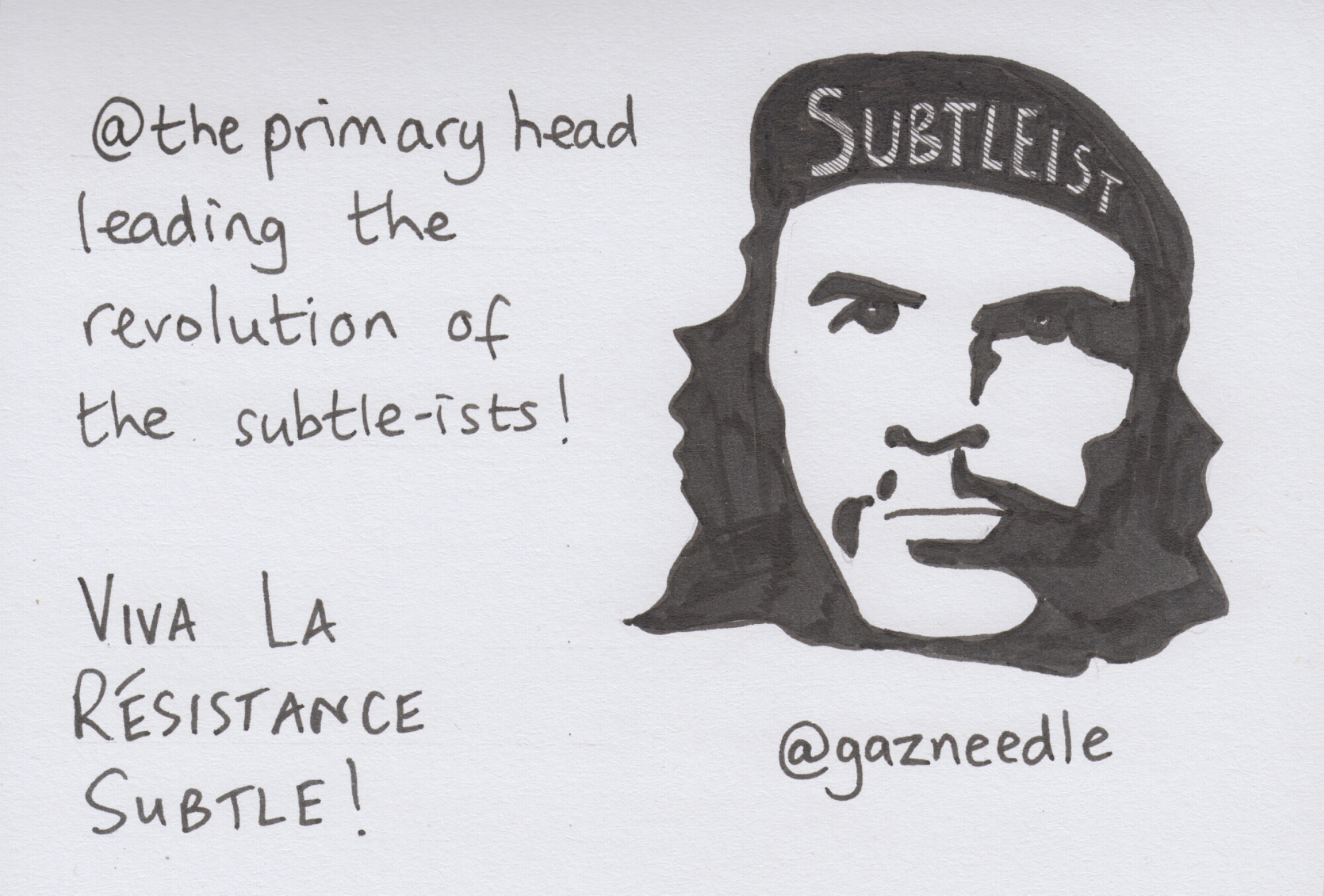
I’ve worked with all types of children in all types of settings and, as I flit between being a traditionalist and a progressive, I have come to realise that there is a third type of teacher that is better than both of them put together (literally). I am talking of course about the ‘subtle’ teacher.

Teaching is a subtle art and I am a subtle teacher. I am a Subtle-ist. By my Bing Dictionary definition this means that I am ‘intelligent, experienced, sensitive enough to make refined judgments and distinctions’. Therefore, I can appreciate the time or the context where a traditionalist approach is appropriate just as much as I can identify the right time and situation to deploy a more progressive mode of teaching. It is through deft deployment of these styles that allowed my pupils to make progress and, as a Head, allows me to run a school (full of bull-headed traditionalists and progressives) successfully. At the end of the day we are all educationalists, which means it is our job to educate the children in our care, which in turn means…we gots to do what works. And I’ve never known one approach work the same for everyone – and I seriously doubt you have either.

So, let’s leave the extended battles to the elves, wizards and talking eagles, and let’s start an underground movement of our own: La Résistance Subtle! Let’s leave the petty name calling and ‘my way or the highway’ nonsense behind and embrace all that is nuanced in education. Let’s agree that it’s ok to change teaching styles depending on what class you’ve got or what you’re teaching, or even what the weather is like (I’ll wager a traditionalist doesn’t let the fact that it’s windy outside get in the way of a maths test). We can do it. We just need to be open to adaptation and try to approach teaching from a subtle-ist’s perspective.

Who’s with me?


image

Modern life is rubbish

I’ll keep it brief: Modern Britain sucks.

I don’t mean that being here, actually living on this small island is bad, for the record, I quite like it – we have a national health service, the BBC, a good solid class system that allows me to feel socially awkward pretty much constantly, and some of the best cheeses known to man. No, living here, suits me down to the ground.

What I dislike about ‘modern Britain’ is that it’s now been appropriated by politicians and become a ‘thing’. Modern Britain has now, apparently, arrived and of course, schools have not noticed. While we’ve been busy teaching girls how to walk in a steady line whilst balancing a pile of books on their heads and developing boys’ aptitude for shimmying up chimneys, the world has moved on.

Modern Britain is totally new. It’s all shiny and fast and touchscreen. And that’s great and people want that. But they also kind of want traditional things, how things used to be – you know, cups of tea, starched shirts, McDonalds. Imagine Britain was like the Booker Prize and the winning book was a mash-up of Thomas Hardy and Irvine Welsh. Modern Britain is exactly like that. Classic, sweary, comfortable, edgy, shabby, chic.

Except…there’s more. According to facts there is also radicalisation, separatism and a poisoning of good old fashioned British values. I’m not sure what these British values are: imperialism, colonialism, Thatcherism? But in between the Old Britain and the New Britain is the Bad Britain. Close your eyes and think of Britain today: you’re probably getting an image of a tattooed Mary Berry piping salted caramel curry sauce on a Yorkshire pudding whilst sexting. That’s modern Britain, red in tooth and claw, and that last bit…that’s the bad bit.

This is the full hard core Britain that we, as educators, were just letting children blindly wander into. But now, thanks to Ofsted that is set to change. No longer can we just get on and try to survive in whatever sort of Britain we wake up to – now we must prepare children for a pre-defined modern Britain; the one that we apparently all want and have subconsciously agreed upon.

There’s just one problem…this idea of Modern Britain is a bit, well, naff. And I say that knowing that I’m discrediting my previous three paragraphs. That’s how sure I am that the people who decided, in the new Ofsted consultation, that schools should prepare pupils for life in modern Britain, hadn’t really thought it through. I mean I put a lot of thought into the Mary Berry bit (a little too long to be honest) and well, even though I reckon that’s the most accurate picture anyone has ever come up with to describe modern Britain, I wouldn’t want to hang my school’s whole curriculum on it – let alone yours!

But soon we’re going to be subjected to proving how we’re preparing children for someone’s idea of modern Britain. How is that going to work? Who is that someone? Why will their version of British values be relevant for my pupils or yours? And does anyone really think it’s going to work?

My suspicion is that this body of work will be reduced to box ticking. All over the country websites will change, ever so slightly, to make sure words like ‘modern’ and ‘British’ and ‘values’ are visible to impending Ofsted inspectors. Every school policy will be updated with identical incidental paragraphs promising that promoting British values is an integral part of school life. During the inspection Heads will do whatever the modern British values equivalent is of lighting a candle in assembly in order to pass it off as ‘collective worship’.

No school will actually sit down and decide for themselves what British values are and how they promote these in their school. And if they did, what would stop a rogue inspector saying ‘No, no, no, these are not British values…these are!’ It’s an inappropriate misappropriated mess.

I don’t doubt that the concept has come from a good place. But seriously…let’s be British about it and think about it sensibly. How about bringing back community cohesion? That was pretty good wasn’t it? Looking at your community, celebrating its strengths and challenging its weaknesses. Working out how you could give your children the best start in, not just modern Britain, but the modern world – an even more rapidly changing place.

Some might say, that schools have been doing this for years, even when community cohesion wasn’t considered cool anymore. Yes, a minority of schools may have failed some of their pupils by not safeguarding them effectively from the more sinister fractions of their community but their failings are lessons learned and taken forward by all of us. We don’t all need another knee-jerked bolted on initiative to put into action…we just need to keep our ears open in order to hear the winds of change because modern Britain doesn’t suck…it blows.