The Golden Age – part 2

When I began teaching, Headship was like the end of a rainbow..out of reach. Partly because I had only begun teaching,  any thoughts towards becoming a Head would have been very odd considering I wasnt quite sure what was higher: a 2C or a 2A? (I actually had to ring my final school, placement mentor to find out). No, if at that stage in my career I had designs on Headship it would have been very worrying and I probably should have left the world of education there and then .  

Another reason however as to why Headship appeared to be an almost mythological state was because of the Head Teachers that were around. In my mind the Head Teachers back then were calossal. Mighty beasts that not only led their school but were the school.  I don’t want to use the word “Maverick”but these were big personalities who seemed untouchable. It was these men and women whose schools were like kingdoms.  When you heard about what this or that Head was doing in his or her school it was like listening to myths from another land. They were at once, to me, all knowing about education but only in their particular domain. I always felt that it would be impossible to become one of them…unless I killed a lion or wrestled a bear or bit the head off a snake in some weird local authority ritual.  

I later worked with one of these leaders at close hand and I was so relieved that they weren’t a disappointment. It was a tough school in a socio-economically depressed part of the city and floor standards were pretty much your wildest dreams.  (Don’t confuse that with staff low expectations however, as a pgce student once made the mistake of actually saying during a staff meeting.) This Head was, to my mind, the only possible person who could lead that school.  

Don’t get me wrong, there were some areas of weakness:  

1. Being able to actually teach (if he was taking your class you would come back at break to find that he had barely taken the register so preoccupied with trying to make the class laugh)
2. Staff communication at times was not brilliant; you found out, for example,  what year group you were teaching next year via letter in your pigeon hole after lunch on the last day… he would have left for the holidays at noon.
3. Zero respect for financial responsibility…each year came the depressing and soul destroying moment of ‘managing change’ which left many staff feeling devalued.
4. Writing a  SEF that was a complete (although at times amusing) work of fiction.  

But there were many, many, many things that cause those weaknesses to evaporate from my mind when I think about his overall contribution to that school community.  He loomed so large on the psyche of the community and committed so much of his life to bringing the community together and unifying them that he remains a significant influence on my own headship.  

I say that even though I believe his breed of Head Teacher is now extinct. For better or for worse schools are no longer led by Kings or Queens trying to protect their castle from the dragons that try to burn them down. (Wow, reading this back makes me think I should hold back on Game of thrones). These Heads have died out as Headship became more… professional?  

I don’t for one minute say that to try and take any level of professionalism away from the Heads of yesteryear… but the job itself has changed. For example:
I can’t employ, without interview, parents from the playground because they seem nice. I can’t have staff favourites (publicly) and offer them internal promotions. I can’t create an SDP priority based upon a personal indulgence. l can’t ignore what my local schools are doing or ignore their achievements over mine.  

Headship has become more transparently accountable and operating as a lone saviour is impossible. When people reminise about the “freedoms” of teaching back then (“I used to decide what my afternoon lessons would be whilst shaving”) or Headship (“Bugger the SIP, I Know what we’re doing”) l occasionally feel, not Sad, but a nostalgic longing for what I may have missed… a golden age? A time of freedoms and of a “my way or the highway” and assurity that you were right without question.

I mean will I inspire a generation of future Heads? Will they write a blog about me saying:  

1. By God he could write a SEF that cut to the chase.
2. He Knew Raise like the back of his hand.
3. I’ll say this for him, he always interviewed if there was a vacancy.
4. The man could budget reasonably well.. no one lost their job but we never managed to equip a fully working ICT suite.  

I’m certain they won’t. Even so, I hope I can be the Head for the community that I saw in that inner city school years ago. The cut corners, I can do without and the independence.  But the total commitment to a school is what drives me, and the changes that have come with the evolution of school improvement are, by me, welcomed. I embrace the partnerships we are creating with local schools in the real world and professional colleagues in the virtual world of twitter. I don’t want to be alone in this very public dashboard of educational judgements. We may not be living in a golden age of education and school leadership may have become more corporate and professionally minded but I wouldn’t necessarily change that.  

Where there are constraints, people will find freedoms through creativity.
When one school “fails” it will succeed through systems and partnerships.
Professionalism and rigid accountability are borne from a true desire to raise standards for all pupils.

As a school Leader I truly feel that we are tantalisingly close to forging education’s new golden age.

The Golden Age – part 1


the-golden-ageThe Golden Age in Greek mythology refers to the first of several sequences of the ‘Ages of Man’.  Being ‘Gold’, it is obviously the best and the subsequent ages: Silver, Bronze, Heroic, and Iron denote a period of steady decline. So, even by the 1st century BC life in general was already past it. Even by the Daily Mail standards this is pretty gloomy but it shows quite neatly that as a race our default setting seems to be: it was better yesterday but enjoy today because it will be worse tomorrow. As a result every single conceivable idea or movement has apparently already had its golden age: Hollywood, comics, sci-fi, hip-hop, there has, I am reliably informed by Wikipedia, even been a golden age of porn-but due to internet restrictions on my broadband I am unable to inform you of when or what that was.

Presumably there was a golden age in education and presumably we all missed it. However our brave Secretary of State for Education, dear little Micky Gove is determined to find it and put it back in its rightful place. This personal quest of his helps to explain why each week he spews out more and more demented policy ideas in the hope that one day he’ll hit gold. He’s not having a great deal of success with this strategy; I mean if you read all of his ideas for schools and education in order it’s as if he’s playing his own version of the BBC game show ‘Pointless’ where he’s gradually trying to find the one idea that absolutely no teacher will like.

Give every school a free bible? ‘Not bad, 85 teachers liked that idea.’

2014 Proposed Curriculum? ‘Ooh that’s a good one, only 35 teachers liked that one.’

Longer school days? ‘Very close, 8 teachers were in favour of that.’

Shorter holidays? ‘Wow, that’s a very low score with only 4 teachers being in favour of that.’

Inset a device into a teacher’s inner ear so they self-destruct after two successive ‘less than good’ lessons as voted for by pupils who weren’t there at the time ? ‘Congratulations! That is a totally pointless answer.’

There are three only possible sensible reasons why Gove seems to be selecting education policy as if he’s playing a blind ‘education policy’ lucky dip whilst taking vast quantities of crystal meth that is having a serious effect on his ability to apply reason:

  1.  He is an idiot.
  2. He is a genius who is subversively managing the government’s plan to have every school a privatised academy by the May bank holiday by enforcing unpopular policy.
  3. He is really bad at playing ‘truth or dare?’

gove

Whatever the reason, one thing is for certain: Thanks to Mr Gove, we are definitely not living in the golden age of education.

Come on Mr Mayor…don’t just plant a tree, sow the seeds of change!

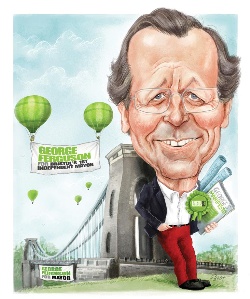
george_ferguson_we_250

Bristol has a Mayor. This is fine, I have nothing against Bristol having a Mayor; in fact I imagine it could be quite exciting, shake things up a bit. Bristol’s Mayor is a man called George Ferguson. So far there are three things that I know about him:

  1. He wears red trousers a lot.
  2. He played a significant and important role in the redevelopment of Bedminster’s Tobacco Factory.
  3. He wants every child in Bristol to plant a tree.

Of these three statements one impresses me and causes me to think all is not lost; one has made me confine the wearing of my own pair of red trousers to when I’m gardening; and one of these statements really, really annoys me. I think it should be clear to most people that the red trousers issue is taken care of; I think the Tobacco Factory is great so that leaves us with statement three: he wants every child in Bristol to plant a tree.

It was a couple of days after his election victory that Mr Ferguson addressed a room full of Head Teachers at the University of the West of England. Poor bugger, he was probably still hung over from celebrating but his PA had obviously said ‘Get on that stage Mr Mayor, this is an opportunity’. So he came on and I remember two feelings: slight surprise because close up his red trousers were actually tartan, but more than that I remember feeling a bit sorry for him. He seemed a bit flustered and who could blame him? He hadn’t talked that much about education before and suddenly here he was talking to a load of Head Teachers, I mean what was he meant to say? Turned out he did some crowd pleasing material on us all being heroes and then, in what I imagined was a stream of consciousness, he said that he wanted every child in Bristol to plant a tree.

I quite naturally ignored this as did most people on my table. It was just a bit of fluff and nonsense designed to sound inspirational in a ‘children are the future of this planet and so are trees’ kind of way. It didn’t carry any weight, no we would forget about this idea. Put it at the back of the cupboard with the other ‘big’ ideas like building a solar powered snow plough and running a competition to find Bristol’s favourite soup.

So imagine my surprise when I received an email asking me to sign up for the Mayor’s big scheme of getting every child in Bristol to plant a tree. Why? Will it make Bristol a green city? Will it provide a safe canopy for our children to walk under on their way to school? I don’t think it will. It might make Bristol a better shaded city in the summer months and it may encourage more tree climbing therein creating a more risk taking generation which could be a good thing but…I think that might be it.

No, what really annoys me about this idea is that it is in danger of being really small minded and for a man who displayed such vision when saving such a culturally significant building as the beloved Tobacco Factory and who proudly wears red tartan trousers in public, this paper thin initiative is a massive disappointment. Education at this precise moment in time is not in the best of places and I would have thought that the proposed National Curriculum, which seems to be unifying all educators through their hatred of it, would be seen as the golden egg squeezed out from Gove’s massive egghole (urgh) to be picked up and capitalised on.

Imagine a whole city turning its back on a badly formatted and politically engineered curriculum and instead creating something truly inspiring and meaningful for its children. A City Curriculum with local and global dimensions agreed upon by all educators and pushed forward by the city’s Mayor. A newly elected Mayor should seize this opportunity to engage with school leaders and play a part in developing something far greater than the sum of its parts. A city curriculum could truly lay the foundations that would allow an entire city becoming ‘outstanding’ based on any set of criteria from anybody’s score-book. Schools may not be able to do it on their own, they carry with them too much baggage, but with a leader or a figurehead to help facilitate the journey we could do it. The Mayor is in the correct neutral position to at least give it a try. Or…we could plant a tree and then get on with teaching 7 year olds about the house of Plantagenet. Your call Mr Mayor.